How better screenshot review preparation can accelerate eCOA implementation




For many Clinical Outcome Assessments (COAs), source English screenshot review is a required part of the licensing process before the COA can be administered electronically to participants. During this step, the COA distributor or copyright holder reviews the electronic version to confirm that it remains faithful to the paper COA, aligns with eCOA best practices, and preserves the COA’s measurement properties.
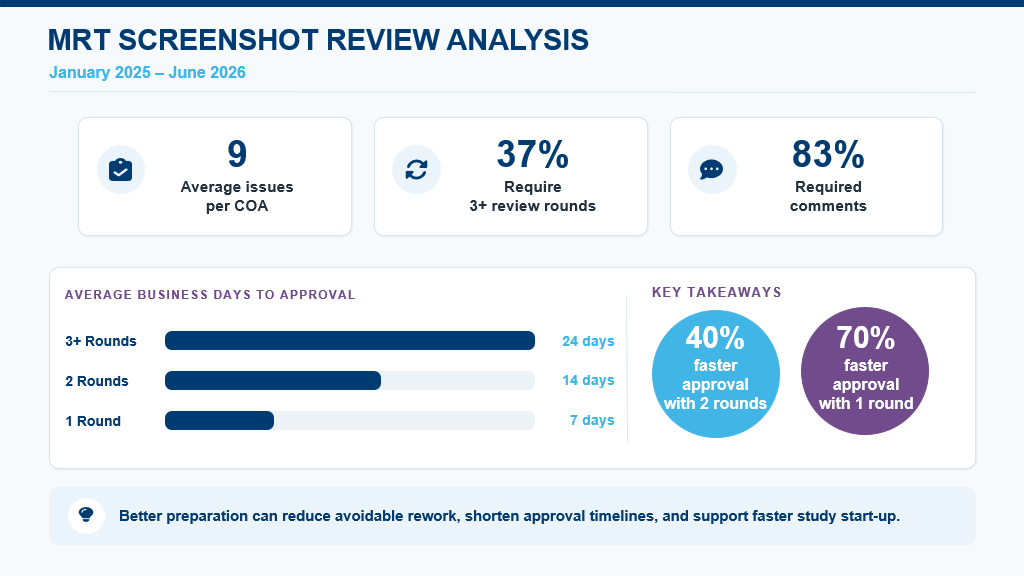
An internal analysis of Mapi Research Trust (MRT) screenshot review data from January 2025 to June 2026 highlights a clear opportunity to improve screenshot review preparation. On average, the first review identifies nine errors per COA that may affect approval, implementation quality, or alignment with the source instrument, while 37% of reviews require three or more rounds before approval. More complete and accurate screenshots at the initial review can reduce avoidable rework, shorten approval timelines, and lower the operational burden for sponsors, eCOA providers, and reviewers.
Each additional review round extends approval timelines
As illustrated in Figure 1, MRT’s data shows that screenshot reviews requiring three or more rounds take an average of 24 business days to approval, compared with 14 business days for two rounds and 7 business days for a single round.
Compared with reviews taking three or more rounds, limiting the process to two rounds reduces approval time by 40%, while achieving approval in a single round reduces it by 70%.
For studies where eCOA is on the critical path, these are meaningful gains. Each additional round creates further coordination between sponsors, eCOA providers, copyright holders, and reviewers. It can also impact downstream activities such as translation, user acceptance testing, and study start-up.
Figure 1. Key Findings from MRT Screenshot Review Analysis (January 2025 to June 2026)
Most review comments must be resolved before approval
The impact of additional review rounds depends not only on the number of comments but also on their significance. MRT classifies comments as Required or Recommended, allowing sponsors and eCOA providers to distinguish approval-blocking issues from advisory improvements.
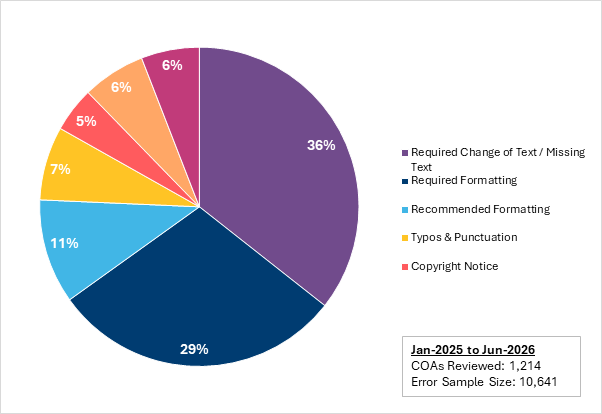
As shown in Figure 2, 83% of comments are Required, meaning they must be resolved before approval can be granted. The most common issues include:
- wording discrepancies from the paper COA
- formatting inconsistencies
- typographical and punctuation errors
- incorrect copyright statements
- missing COA images, graphics, or logos
- incorrect scale implementation
The remaining 17% are Recommended comments. Although these do not block approval, they promote greater consistency, usability, and alignment with eCOA best practices (Mowlem et al., 2024). Examples include:
- alignment and font-size adjustments
- presenting one question per screen (for smartphones)
- adding a final ‘Save and Submit’ screen
A key takeaway is that many of these issues are avoidable. Wording, formatting, typographical, copyright, image, and scale-implementation errors can often be identified through robust internal quality checks before screenshots are submitted to the copyright holder or distributor.
Figure 2. Distribution of Common Error Categories Identified During Screenshot Review
Complex COAs require earlier planning
Some COAs contain features that are more difficult to migrate correctly to an electronic format. In these cases, the consequences of poor implementation go beyond approval delays, potentially affecting comparability between paper and electronic versions, patient comprehension, usability, and data quality.
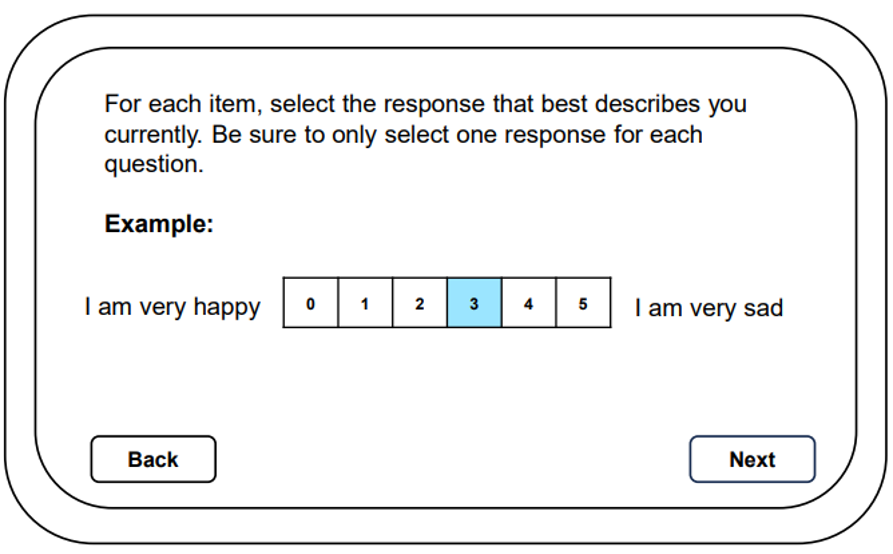
For example, sample questions in a paper COA may show respondents how to complete the questionnaire (see Figure 3). In the electronic version, they must be clearly identifiable as examples rather than active questions.
In one case, a sponsor contacted MRT after an eCOA migration had been implemented and launched without MRT’s involvement. A sample question had been configured without a shaded or pre-selected response. Participants attempted to interact with it, could not proceed, and exited the questionnaire prematurely, resulting in missing data and participant frustration.
Figure 3. Recommended Implementation of a Sample Question Screen
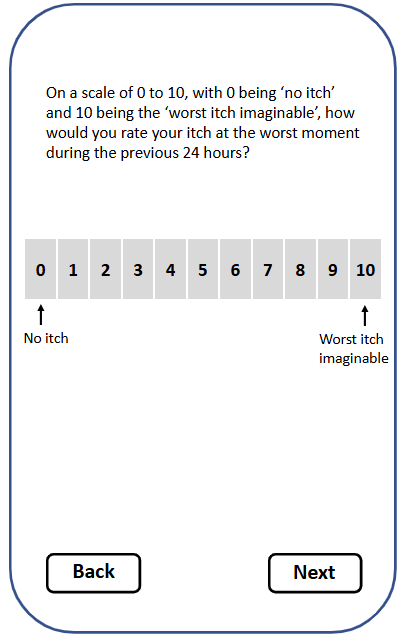
Numeric Rating Scales (NRS) can also be challenging to present, particularly on smartphone screens. In another MRT review, an eCOA provider could not support a horizontal NRS on smartphones for a Bring Your Own Device (BYOD) study. The original implementation could have affected how participants interpreted and interacted with the scale because the spacing and text alignment were not optimised for the intended device. This platform limitation only became apparent once screenshots were available for review, requiring the sponsor to reconsider the planned devices. Following consultation, the sponsor decided to change from BYOD to provisioned tablets. Although this resolved the implementation issue, earlier confirmation of platform capability could have prevented the resulting delay.
Figure 4. Recommended Smartphone Implementation of a Numeric Rating Scale (NRS)
Together, these cases show why implementation requirements should be assessed as early as possible, and any challenges should be discussed with the relevant copyright holder or distributor so a suitable alternative can be agreed upon before the build begins.
Practical ways to prepare for screenshot review
Sponsors and eCOA providers can take these practical steps before submitting screenshots for initial review:
- Conduct thorough internal quality checks - Compare screenshots carefully with the source COA, checking wording, punctuation, formatting, images, scale presentation, and copyright statements. After implementing requested changes, complete another thorough check and resolve any open questions before resubmitting screens for the next round.
- Maintain source COA integrity - Do not change wording unless necessary for electronic administration or agreed with the copyright holder or distributor. Substantial changes to wording may jeopardise measurement comparability with the validated COA and affect regulatory acceptance.
- Engage early on complex implementations - If a COA includes sample questions, conditional logic, Numeric Rating Scales or Visual Analogue Scales, or specific navigation requirements, clarify expectations with the copyright holder or distributor as early as possible.
- Confirm platform capability upfront - Verify that the proposed platform and devices can support the required design, particularly in BYOD studies or on smartphone screens. Capability checks should be part of provider selection.
- Use available eCOA implementation guidance - Where available, eBooklets and other implementation guidance provide reference screens and approved approaches to platform limitations. MRT’s analysis indicates that COAs supported by eBooklets are associated with fewer review comments and faster turnaround times than those without guidance.
Better screenshot review preparation drives faster approvals
Screenshot review is a critical quality step in COA licensing and electronic implementation. MRT’s data indicates that complete and accurate screenshots at the initial review support faster approval by the copyright holder or distributor.
By completing robust internal checks, preserving source COA integrity, and planning early for complex designs, sponsors and eCOA providers can reduce avoidable rework, shorten approval timelines, and keep eCOA start-up on track. Engaging the relevant copyright holder or distributor before the build begins is the most effective way to clarify expectations and address implementation constraints early.
Thank you to Amanda Regalin - Senior Client Services Associate, Florent Campo-Paysaa - Senior Project Manager, and Jack Hannigan - Team Lead, for their contributions to this article.