Measuring What Really Matters: The Challenge (and Promise) of Whole Health




For decades, health outcomes research has asked a familiar set of questions: How does a patient feel? How well do they function physically, socially, and emotionally? These dimensions, along with clinical signs and symptoms, have shaped how we understand and measure quality of life.
These dimensions tell us a great deal about a person’s health, but they do not tell the whole story.
Enter Whole Health, a term that may be relatively new, but describes an idea that’s been quietly evolving for years. Whole Health broadens health outcomes measurement to encompass the many interconnected factors that shape health, including environmental, spiritual, and economic factors, the very things that shape our daily lives and, ultimately, our health outcomes. It’s no surprise that ISPOR’s 2030 Strategy places Whole Health firmly on the agenda.
So here’s the big question we set out to answer: How can we measure Whole Health?
What is “Whole” Health?
Whole health is an approach to well-being that focuses on the whole person rather than just treating a specific disease or symptom. It balances physical, behavioral, spiritual, and social health, and centers care around a person's values, life goals, and personal purpose. Drawing on ISPOR’s and the National Academies’ literature, we developed a conceptual model covering the full spectrum of Whole Health sub-concepts, from the familiar (physical, social, psychological functioning) to the often-overlooked (environmental exposure, spirituality, and economic stability), see Figure 1.
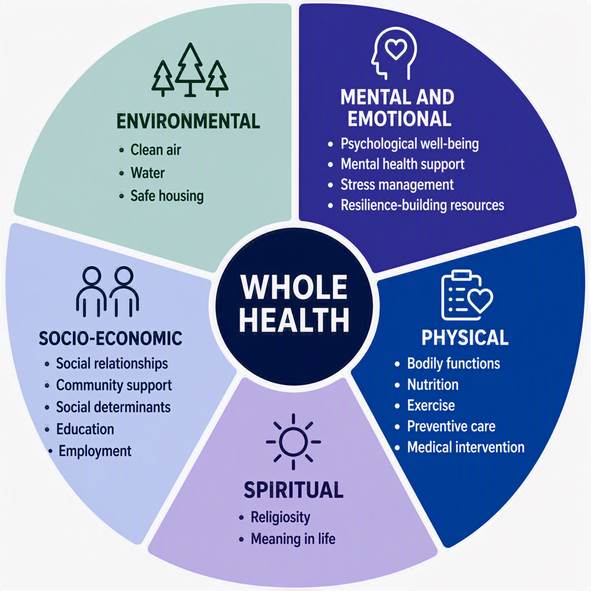
Figure 1: Whole Health Model
Searching for the right tools
To identify how best to measure whole health, we used our conceptual model to help us identify relevant outcome assessments, by looking for tools which measured these key concepts. Our first stop was PROQOLID™, a comprehensive COA library describing over 9000 COAs, where we conducted targeted keyword searches to identify instruments addressing at least two Whole Health sub-concepts, especially those beyond the traditional clinical focus.
After removing duplicates, we identified 129 COAs. However, only ten of these COAs actually covered all Whole Health concepts.
These included:
- General population questionnaires like WHOQOL-100 and the more recent SigQOLM-36
- Tools designed for mental health contexts, such as CAN-M and QLS-BC
- Population-specific instruments for older adults (OPQOL) and caregivers of people with terminal illness (QOLLTI-F)
However, there are certain limitations to the widespread application of these COAs including the range of therapeutic indications they are designed for and the length of several of these COAs which can increase respondent burden.
Moreover, across the COAs we reviewed, environmental factors were measured by very few COAs.
To address this, we expanded our search beyond traditional assessments and turned to Atlas, a platform indexing more than 20,000 digital measures and digital biomarkers from 4,000+ digital health technologies. Here, we identified 25 environment-related sub-concepts and 290 digital health technologies designed to capture them.
The three most frequently used technologies were most commonly associated with these sub-concepts:
- Humidity
- Ambient sound
- Ambient temperature
- Particulate Matter (PM2.5]
- Volatile Organic Compounds
Looking at all of the technologies, we saw that they are being used across a range of contexts, with the most frequent applications seen in:
- The general population
- Diabetes or Parkinson’s disease
In other words, while questionnaires struggle to capture the environmental aspect of Whole Health, DHTs are already stepping in to fill the gap.
So where does this leave Whole Health measurement?
Our findings paint a mixed but hopeful picture. There are COAs that measure Whole Health in a reasonably comprehensive way, and interest in this space is clearly growing. However, many existing tools are long, population-specific, or impractical for widespread use. And when it comes to environmental factors, traditional assessments fall short.
Digital health technologies offer a powerful complement to COAs, particularly for environmental measurement. Further, they can offer continuous real-world data to help fill in the blanks between COA administration. Used together, COAs and DHTs could capture a fuller picture of health and measure patients’ lived experience more comprehensively.
Looking ahead
If we want to measure what truly matters to patients and align with the vision set out in ISPOR’s 2030 Strategy, then Whole Health can’t remain just a concept. It needs practical, scalable measurement solutions.
At Mapi Research Trust we are already considering Whole Health in our understanding of COA measurement, and blending tried-and-tested clinical outcome assessments with innovative digital tools may be the key to measuring health holistically, realistically, and in a meaningful way for patients.
Work with Mapi Research Trust to access the COAs identified in this review and see which digital health technologies could fill environmental measurement gaps.
Thank you to Tilly Stott, Research Associate II, and Nadine Kraft, Principal, for their contributions to this article.
References
[1] National Academies of Sciences, Engineering, and Medicine; Health and Medicine Division; Board on Health Care Services; Committee on Transforming Health Care to Create Whole Health: Strategies to Assess, Scale, and Spread the Whole Person Approach to Health; Meisnere M, South-Paul J, Krist AH, editors. Achieving Whole Health: A New Approach for Veterans and the Nation. Washington (DC): National Academies Press (US); 2023 Feb 15. 2, Defining Whole Health. Available from: https://www.ncbi.nlm.nih.gov/books/NBK591719/ [Accessed on 11-03-2026]
[2] ISPOR. Mapping the Journey to the Future: Framing ISPOR’s New Strategic Plan 2030. No date. Available at: https://www.ispor.org/docs/default-source/ispor-good-practices-for-outcomes-research-index/ispor-strategic-plan-2030_web_001202400716.pdf?sfvrsn=6d764c17_2 [Accessed 04-06-2026].
[3] National Academies of Sciences, Engineering, and Medicine; Health and Medicine Division; Board on Health Care Services; Committee on Transforming Health Care to Create Whole Health: Strategies to Assess, Scale, and Spread the Whole Person Approach to Health; Meisnere M, South-Paul J, Krist AH, editors. Achieving Whole Health: A New Approach for Veterans and the Nation. Washington (DC): National Academies Press (US); 2023 Feb 15. 2, Defining Whole Health. Available from: https://www.ncbi.nlm.nih.gov/books/NBK591719/ [Accessed 26-08-2026]
[4] Devlin NJ, Mullins CD, van Baal P. What Does 'Whole Health' Really Mean for Health Economics and Outcomes Research? Value Health. 2025 May;28(5):699-701; Nabyonga-Orem J, Aidam K, Banda R. Whole Health: A Global Perspective. Value Health. 2025 May;28(5):705-708; Pizzi LT, Abbott RM, Onukwugha E. Taking Health Economics and Outcomes Research Forward: Expanding the Definition of Value to Include Whole Health. Value Health. 2025 May;28(5):702-704.
[5] National Academies of Sciences, Engineering, and Medicine; Health and Medicine Division; Board on Health Care Services; Committee on Transforming Health Care to Create Whole Health: Strategies to Assess, Scale, and Spread the Whole Person Approach to Health; Meisnere M, South-Paul J, Krist AH, editors. Achieving Whole Health: A New Approach for Veterans and the Nation. Washington (DC): National Academies Press (US); 2023 Feb 15. 2, Defining Whole Health. Available from: https://www.ncbi.nlm.nih.gov/books/NBK591719/ [Accessed on 11-03-2026]
[6] Mapi Research Trust. PROQOLIDTM – via ePROVIDETM. Available at: https://eprovide.mapi-trust.org/advanced-search?database=proqolid. [Accessed on 09-03-2026].
[7] Aiyegbusi OL, Roydhouse J, Rivera SC, Kamudoni P, Schache P, Wilson R, Stephens R, Calvert M. Key considerations to reduce or address respondent burden in patient-reported outcome (PRO) data collection. Nat Commun. 2022 Oct 12;13(1):6026.
[8] Mapi Research Trust. AtlasTM. Available at: https://app.gohumanfirst.com/atlas [Accessed on 19-03-2026].